Who Owns This Property? How to Find the Owner of Any House
Property ownership in the United States is public record. To find out who owns a specific house, search the county assessor where the parcel sits — that returns the owner name and the tax mailing address in about two minutes, free. To read the deed itself, search the county recorder. Both routes are open to anyone, and the owner is never told you looked.
This guide answers the question directly, then goes further than the county can: what the owner name actually tells you, whether that owner lives in the house, what the record says about their equity and their situation, and what to do when the name on the deed turns out to be an LLC, a trust or an estate. It also says plainly where every route fails, and answers the question investors ask behind this one: whether that owner is a motivated seller.

Is property ownership public record in the United States?
Property ownership is public record in all 50 states. Every transfer of a house is recorded as a deed at the county level, and every county maintains a tax roll naming the party responsible for the bill. Anyone may search those records without permission from the owner, without stating a reason, and without triggering any notice to them. Roughly 3,000 counties each publish their own version.
Two offices hold the two halves of the answer, and confusing them is the most common reason a search goes nowhere:
- The assessor — sometimes the property appraiser, the tax commissioner or the board of assessors — keeps the tax roll. It names the taxpayer of record and, critically, the address the tax bill is mailed to. This is the fastest place to get a name from a street address, and it holds most of what a property record contains.
- The recorder — sometimes the register of deeds, the county clerk or the land records office — keeps the instruments themselves: deeds, mortgages, liens, easements and releases. This is where you confirm how the owner got title and what is recorded against it.
For the full ranked comparison of every route, read how to find out who owns a property.
How do I find out who owns this property for free?
The free method is the county assessor's online property search, and it works for most US addresses in under two minutes. Search the city or ZIP plus the word assessor, open the county site, enter the street address, and read the owner name off the parcel page. No account, no fee, no request form. A minority of counties still require an in-person visit.
The steps:
- Identify the county the property sits in. Search the city or ZIP code plus the word assessor. Florida calls the office the property appraiser, Georgia the tax commissioner, Massachusetts the board of assessors.
- Search the assessor site by street address. Enter the house number and street name without the suffix if the search is strict, because 412 Maple often returns a result where 412 Maple Street NW returns nothing.
- Read the owner name and the mailing address as two separate fields. When the mailing address is not the house you searched, the owner does not live there.
- Write down the parcel number, also called the APN or folio number. You need it to pull deeds, and it is the only identifier that stays stable when an address is renumbered.
- Search the county recorder by parcel number to read the deed itself, the mortgages recorded against it, and any liens. Copies usually cost a few dollars per document.
If the county site defeats you, an address-first lookup is the alternative — see find a property owner by address. Three county searches that work well and show what a good one looks like: Philadelphia, Cook County, Illinois and Massachusetts Land Records. If you need one owner name once, stop here. You do not need software for a single lookup.
Who is the legal owner named on the deed?
The deed is the instrument that establishes ownership, and the name on the most recently recorded deed is the legal owner. The assessor's roll names the taxpayer, which is usually the same person but not always — a lender servicing an escrow account, a life tenant, or an ex-spouse who kept paying can all appear on a tax roll without holding title. When the two disagree, the deed wins.
What a deed search adds:
- How the owner got title. A warranty deed means an arm's-length purchase. A quitclaim deed usually means a transfer inside a family, into a trust or out of a divorce. A trustee's or sheriff's deed means foreclosure.
- Who else is on title. Joint tenants, tenants in common and a spouse added years after purchase show here and nowhere else.
- What is recorded against the property. Mortgages, judgment liens, mechanics liens, HOA liens and IRS liens each name a party who must be paid before clean title transfers.
- The recording date. This is the date that matters for priority, not the date on the signature line.
Deeds, loan history and recording dates all sit on what's in a property record alongside the assessor fields. Most recorders let you search the index free and charge a few dollars per page for the image. The index alone tells you a lot: five instruments recorded in eighteen months is a different story from one deed and nothing since 1994.
Can I find a property owner from a parcel map?
Most counties publish a GIS parcel viewer, usually built on ArcGIS, that lets you click any parcel on a map and read its owner, parcel number, acreage and assessed value. This solves the case where you know exactly which house you mean but cannot get a reliable address for it — corner lots, flag lots, houses set back off the road, vacant land, and rural parcels where the mailbox is half a mile from the building.
Search the county name plus GIS or parcel viewer. What you get varies more than the assessor search does: some counties render a full ownership popup on click, some show only the parcel number, and some publish no map at all. Aerial imagery is often two to four years old, so a building on your screen may already be demolished.
The GIS route is slower than an assessor search and takes practice to read boundaries against the street, but it costs nothing and works on land no address describes. Where you have an address, nationwide property search is faster.
Who owns the house I am standing in front of?
SCOUTRE identifies the owner of any U.S. property from the property itself. Stand in front of the house and GPS matches the exact parcel, or type the address from anywhere, across 160 million U.S. properties at roughly 95% coverage. Coverage varies by county.
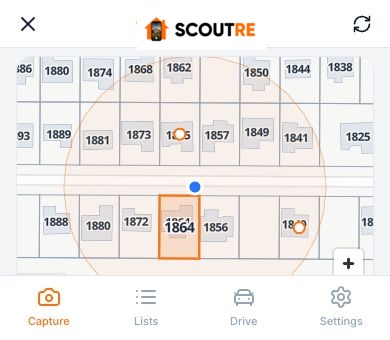
The problem this solves is specific to fieldwork. The house that catches your eye is rarely the one with a legible number: it has weathered off the curb, or sits on a mailbox forty feet from the road, or three houses share a driveway. Type the address you assumed and you pull the neighbour's record.
Property in Front resolves the parcel from where you are standing and returns the record for it, with a photo, a voice note and a written note saved against that parcel in the same screen. If you are in a dead zone, the capture and the photos save to the phone and upload when signal returns, so a rural afternoon does not evaporate. The nationwide property search covers the other case, when you have an address and are nowhere near the house.
Does the owner live in the house, or somewhere else?
The answer sits in one comparison: the property address against the owner's mailing address. When a county record shows the tax bill going to the same house, the owner almost certainly lives there. When it goes somewhere else — another town, another state, a PO box, a management company — the owner does not live in the house, and whoever answers the door is a tenant, a relative or a caretaker.

That comparison changes everything downstream. An owner-occupant is having a conversation about their home. An out-of-state owner is having one about an asset, often inherited and often unseen for years. The two need different letters and different timing, and confusing them is why most first contact goes nowhere. The mailing address is also where postcards and handwritten letters have to go.
Two secondary fields sharpen the picture. A homestead exemption is direct evidence of owner occupancy in the states that grant it, so its absence on a house that looks like a family home is worth noticing. And a purchase in 1994 with no refinance describes a very different owner from one eight months ago.
What else does a property record say about the owner?
SCOUTRE flags 16 signals on a property record: preforeclosure, probate or inherited, tax lien, other liens, absentee owner, out-of-state owner, vacant, high equity, free and clear, auction, bank owned, long-term owner, recent transfer, no homestead exemption, low down payment at last sale, and MLS activity. Signal availability varies by property, county and source.
These are set out one by one on the 16 distress signals. What each means:
- Preforeclosure — a default filing is recorded against the property.
- Probate or inherited — the property appears to have passed through an estate.
- Tax lien — unpaid property taxes are recorded against the parcel.
- Other liens — mechanics, judgment, HOA or municipal liens.
- Absentee owner — the owner mailing address differs from the property address.
- Out-of-state owner — the owner mailing address is in a different state.
- Vacant — indicators suggest nobody is living in the property.
- High equity — estimated equity is a large share of estimated value.
- Free and clear — no active mortgage appears on record.
- Auction — the property is scheduled for or has been through auction.
- Bank owned — a lender holds title following foreclosure.
- Long-term owner — the current owner has held the property for many years.
- Recent transfer — title changed hands recently.
- No homestead exemption — the owner is not claiming the exemption available to primary residents.
- Low down payment at last sale — the purchase was financed with minimal equity.
- MLS activity — the property is listed, was recently listed, or has been withdrawn or expired.
Estimated value, estimated equity and estimated mortgage balance are estimates derived from recorded loan history and assessed values — not statements of account balance, and not appraisals. Treat them as the opening of a conversation, never as a number for a contract. On which signals repay attention first, read the distress signals that actually convert.
How do you tell if an owner is a motivated seller?
One signal on its own means very little. Preforeclosure alongside high equity and an out-of-state owner describes somebody with both a reason to sell and the room to do it, which is what the phrase motivated seller actually means. SCOUTRE flags all 16 signals on a property you have added, from the kerb or by address, so the combination is readable before you make contact. Availability varies by property, county and source.
Who can tell you who owns a house when the records cannot?
People know things records do not. A neighbour two doors down usually knows whether the family moved to Arizona, whether the son has handled it since the mother died, and whether somebody already knocked last spring. A letter carrier knows where mail forwards. None of this is on a deed, and all of it changes how you approach the owner.
The routes worth trying:
- Neighbours. Ask about the house, not the owner. "Do you know if anyone is looking after that place?" gets an answer; "who owns that house?" gets a closed door.
- The posted notice. Code enforcement placards, utility shutoff notices and lockbox tags carry a case number or company name you can search.
- A title company. Most run a property profile for an established client at no charge, returning owner, legal description, deed history and open liens in one PDF. It is the professional's shortcut, and it depends entirely on the relationship.
- The listing agent. If the property has MLS history, the last agent on it knows the owner's situation and is usually willing to talk.
Treat everything gathered this way as a lead to verify against the record. Neighbours misremember names, and a company named on a placard is often a contractor rather than an owner. Working a neighbourhood systematically is covered in the driving for dollars field guide.
What can you see at the house that no record shows?
SCOUTRE flags vacancy as one of 16 property signals, and lets you record what you actually saw. Standing at the house you can tag boarded windows, accumulated mail, an overgrown lawn, peeling paint, a damaged roof, a cluttered driveway, code notices or vacancy signs, add photos and a voice note, and rate distress from 1 to 5. A data provider cannot see peeling paint.
Ownership records describe legal and financial status, not condition. A parcel can be free and clear, current on taxes, held by the same family since 1988, and still have a tarp on the roof. Nothing in a county database has ever driven down the street. Photos, voice notes and the tag sets sit under field documentation.
Field observations also date-stamp the situation. A photo with a distress rating and a note is evidence you can revisit six months later, and referencing the actual roof when you write to the owner reads as a person who has been there rather than a mailing list.
Which route should you use?
Choose by how many properties you need and how much you need to know about each. One name, once, is a county assessor job and costs nothing. A deed history and lien picture is a recorder job. A full picture of the owner's position, repeated across dozens of properties, is where a paid database starts to pay for itself.
| Route | Cost | Time | What it returns | Where it fails |
|---|---|---|---|---|
| County assessor search | $0 | 2 minutes | Owner name, mailing address, parcel number, assessed value | Counties with no online search; recent sales not yet on the roll |
| County recorder / deeds | $0 index, a few dollars per document | 10–30 minutes | Deed history, mortgages, liens, recording dates | Older records not digitised; name-based indexes with spelling variants |
| County GIS parcel map | $0 | 5 minutes | Owner from a map click, parcel boundary, acreage | Not every county publishes one; aerial imagery years out of date |
| Ask a neighbour or the listing agent | $0 | Minutes to days | Situation, family context, who has been asking | Unverifiable; people misremember and sometimes decline |
| Title company property profile | $0 for an established client | Hours to a day | Owner, legal description, deed chain, open liens | Requires a relationship; not available to the general public |
| Mail to the tax address | Postage, or from $0.50 through SCOUTRE | Days in transit | Contact with whoever pays the tax bill | Silence is not an answer; forwarding expires |
| SCOUTRE | $79/month, 3 days free | Seconds per property | Owner, mailing address, occupancy, estimated equity, 16 signals, contact paths | No market-wide search; coverage varies by county |
The honest summary: the county wins on cost and authority, outright, if you have one property. A paid tool wins on the fiftieth, and on everything the county does not hold — occupancy, equity position and a phone number. That crossover arrives early for SCOUTRE for wholesalers and later for a homeowner checking one neighbour.
When will an ownership lookup not give you a clean answer?
Recording lag defeats more ownership searches than anything else. A deed recorded last week may not reach the assessor's roll for 30 to 90 days depending on the county, so the free county search and every database built on it can still show the prior owner. SCOUTRE processes daily and inherits that lag exactly as each county publishes it. Coverage varies by county.
Where else the answer comes back incomplete:
- Non-disclosure states. Parts of Texas, Utah, Idaho, New Mexico and Alaska do not make sale prices public, so value and equity estimates anywhere in those states rest on much thinner evidence.
- Condominiums and multi-unit buildings. A search may return the building or the association rather than the unit owner. Search by unit number and parcel number, not by street address alone.
- Manufactured and mobile homes. In many states these are titled as vehicles rather than real property, so the land has one owner in the county record and the home has another at the motor vehicle agency.
- Address confidentiality programs. Several states let survivors of domestic violence and certain judicial and law enforcement officers shield their names from public property records. Those records return no name, by design, and that is the correct outcome.
- Rural and unincorporated addresses. Mail routes and physical parcels frequently disagree, and parcel data can be coarse enough to drop the pin in the wrong field.
- Counties with limited digital records. A minority publish almost nothing online and require a written or in-person request, costing days and sometimes a fee.
Where a record is thin, it is thin at the source. A product showing confident numbers on a parcel its county knows nothing about is modelling, not reporting.
What if the owner is an LLC, a trust or an estate?
An entity on the deed is still a correct answer to the ownership question, and still a dead end for contacting anyone. The county has told you the truth: the legal owner is a company or a trust. Getting from that name to a person who can decide to sell takes a second search, in a different registry, and the registry depends on which kind of entity you are looking at.
- LLC or corporation. Search your state's Secretary of State business registry by the exact entity name. The filing lists a registered agent and, in most states, a member, manager or officer with a mailing address. Where the agent is a commercial service, read the annual report instead.
- Revocable, family or land trust. The trustee is sometimes named on the deed. Where it is not, the tax mailing address is the practical route — mail sent there generally reaches whoever administers the trust. Illinois and Florida land trusts are built specifically to keep the beneficiary private and frequently cannot be resolved online at all.
- Estate of, or a deceased owner. Search the county probate index for a case in that name. The petitioner or personal representative has authority to sell, and the file usually carries their address.
- Bank or servicer. The property is almost certainly REO. The asset manager will not take your call; the listing agent will.
- Municipality or land bank. These sell through a published process with its own rules and deadlines. Search the land bank directly rather than writing to the address on the roll.
SCOUTRE flags probate or inherited and bank owned among its 16 signals and returns the mailing address of record whatever the entity type, which is frequently the fastest way to a human when a registry search dead-ends. It does not resolve an LLC to its members for you — that search happens at the Secretary of State, and it is free.
Is it legal to look up who owns a property?
Looking up who owns a property is legal everywhere in the United States. Deeds, tax rolls and lien filings are public records in every state, searching them needs no permission and sends no notice to the owner, and anyone may walk into a county recorder's office and ask. SCOUTRE assembles the same public records from into a faster search across 160 million US properties. Coverage varies by county.
Two boundaries are worth knowing, and neither is about the lookup itself.
Property and skip trace data is not consumer report data. It must not be used for tenant screening, employment decisions, credit decisions or insurance underwriting, all of which are governed by the Fair Credit Reporting Act and require an FCRA-compliant consumer reporting agency. That restriction applies to the purpose, not the tool, so it holds however you obtained the record.
Contacting the owner is separately regulated. Calls and texts fall under the TCPA and state do-not-call rules. SCOUTRE surfaces Federal DNC, State DNC, DMA suppression and known-litigator indicators on the records it returns; you remain the caller of record and responsible for your own compliance. None of this is legal advice.
What does each route cost?
Finding out who owns a property costs nothing if you use the county. The assessor search is free, the recorder's index is free, the GIS map is free, and a document copy runs a few dollars per page. A title company property profile is usually free to an established client. Every route in the free column is genuinely free, and for a single property none of them is worth improving on.
The costs start when the volume does. A new county website for every property, retyping addresses, chasing a mailing address into a separate deed search and still having no phone number is the real price of the free route, paid in hours rather than dollars.
SCOUTRE is $79 per month on a single plan after a 3-day free trial, cancel anytime. Nationwide property search, Property in Front, the 16 signals, unmetered skip tracing and re-tracing, the 11-stage pipeline, offline field capture, deal analysis and the Apple Watch app are all included. The only pay-per-use item is physical mail, charged on your approval: postcards from $0.50 and handwritten letters from $0.83, print and postage included. Full detail is on SCOUTRE pricing.
How does SCOUTRE answer who owns this property?
SCOUTRE resolves ownership two ways and returns one record either way. Stand in front of a house and GPS identifies the exact parcel with nothing typed, or type any US address from anywhere. The record carries owner name, owner mailing address, owner occupancy, estimated value and equity, loan and sale history, taxes, deeds, comparable sales and the 16 signals, across roughly 160 million US properties. Coverage varies by county.

After the lookup, the record stops being a search result and becomes work:
- Save the property. It becomes a lead in your own pipeline with the photo, voice note and distress rating attached to the same record.
- Run a trace. Real estate skip tracing runs against live sources at the moment you request it and returns phone numbers classified wireless or landline, email addresses and a mailing address, screened against Federal DNC, State DNC, DMA suppression and known-litigator flags. Hit rates vary by property and county.
- Reach the owner on your own terms. Tap an email address and your own email client opens with a template filled in; tap a number and your own dialer opens from your real number. SCOUTRE does not send email, texts or calls on your behalf, and it does not log them afterwards.
- Send something physical. A postcard or handwritten letter goes out from the lead carrying the actual photo of the house, with a proof shown before you approve payment. See direct mail postcards and letters.
- Work it to a decision. Deal analysis runs ARV, repairs, motivation, strategy, offer and deal summary across six exit strategies.
One limit worth stating plainly, because it is a design choice rather than an oversight: SCOUTRE has no market-wide property search. You cannot ask it for every absentee owner in a ZIP code; the 30+ filters operate on the leads you have already saved. There is also no CSV import, no export, and one user per account. What SCOUTRE does covers the rest.
Frequently asked questions
How do I find out who owns the house next door?
Search your county assessor property search by the neighbouring street address. The record returns the owner name and the tax mailing address. If that mailing address is not the house next door, the person living there is a tenant and the owner lives somewhere else. The search is free and the owner is never notified.
How do I find out if a property has an absentee owner?
An absentee owner is someone who owns a property but does not live in it. SCOUTRE flags absentee owner and out-of-state owner as two of its 16 signals, and shows the owner's mailing address separately from the property address, so your letter reaches the owner in another state rather than the tenant in the house.
What does it mean when the mailing address is different from the property address?
A mailing address that differs from the property address means the owner does not live in the house. They are a landlord, an heir, or someone who moved and kept the property. The free county record carries the same field.
Who owns this house if the deed names a trust?
The trust is the legal owner of the house. The trustee is sometimes named on the deed itself; where the deed is silent, the tax mailing address is the practical route to whoever administers it. Land trusts in Illinois and Florida are designed to keep the beneficiary private and often cannot be resolved online.
Does the owner know when I look up their property?
No notification reaches a property owner when someone searches their record. County assessor searches, recorder searches and commercial database lookups all read published public records. The owner learns you are interested when you contact them, not before.
How current is the owner name on a property record?
Owner names lag reality by the recording cycle of the county. A deed signed today is typically recorded within days, then flows onto the assessor roll over 30 to 90 days depending on the county. SCOUTRE sources its data from county records, but it cannot be more current than the county it reads. Coverage varies by county.
Why does the county record show a name I know is wrong?
Three causes account for most wrong names. The sale has not finished recording, so the roll still shows the seller. The owner died and the estate has not transferred title yet. Or the deed moved the house into an LLC or a trust while the same family kept living there. Read the deed history before concluding the record is broken.
Can I find out who owns a property without knowing the address?
Yes. Two routes work without an address. The county GIS parcel viewer lets you click the parcel on a map and read its owner. SCOUTRE's Property in Front uses your phone GPS to identify the exact parcel you are facing and returns the record with nothing typed. Coverage varies by county.
Who owns a house that looks abandoned but has no vacancy notice?
The county record still names an owner, because a property does not stop being owned when it stops being occupied. Search the assessor by address, then check the recorder for tax liens and code enforcement filings. Unpaid taxes plus an out-of-area mailing address is the usual pattern behind a house nobody appears to be maintaining.
Can I find out who owns a property in another state?
Yes, though the free route means learning a new county website for every state. Each of the roughly 3,000 US counties publishes its own search with its own quirks. SCOUTRE covers approximately 160 million US properties nationwide from one lookup, so the process does not change when the property does. Coverage varies by county.
Is there a national database of property owners?
No single government database holds ownership for the whole United States. Ownership is recorded county by county, which is why every nationwide product is an aggregation of thousands of county sources rather than one authoritative file. Where a county publishes thin data, every product built on that county is thin in the same way.
What is the difference between the owner of record and the beneficial owner?
The owner of record is the name on the recorded deed, which may be an LLC, a trust or an estate. The beneficial owner is the human being who actually benefits from the property. Public records name the first reliably and the second only sometimes, which is why entity-owned parcels need a Secretary of State or probate search.
How do you find motivated sellers before they list?
By reading the owner's circumstances rather than waiting for a listing. Preforeclosure filings, probate cases, tax liens, vacancy indicators and absentee ownership are all recorded somewhere, and each gives an owner a reason to sell. SCOUTRE flags 16 such signals on a property you have added, one property at a time. Availability varies by property, county and source.
Know who owns it before you knock
3 days free, then $79 per month. Nationwide property search, Property in Front, the 16 signals and unmetered skip tracing. Cancel anytime.
Start free